
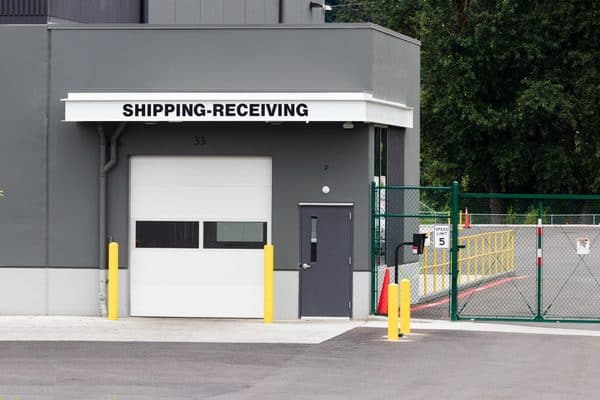
Industrial sites run on vehicle throughput. Trucks stage at a scale house, contractors cycle through a fence line, employees queue at shift change, and every one of those movements has to be authorized without becoming a bottleneck. Keys get copied, PIN pads get shared, and a guard checking a list is a cost that scales with traffic.
An industrial RFID reader removes the stop. The credential is read while the vehicle is moving, with no line of sight and no driver interaction. The harder question is which reader, because the specification that decides it is rarely the one on the front of the data sheet. This guide covers the four site questions that narrow EMX’s line to one answer.
What an RFID Reader Does in the System
In a standard install, the reader is a sensor. It captures a tag ID and passes it upstream to a controller, which checks the ID against an authorized list, decides, and triggers the relay. The reader itself doesn’t decide anything.
That division matters when you spec, because several things buyers shop for at the reader actually live at the controller. Event logs, user capacity in the tens of thousands, and multi-gate coordination are controller functions, handled by the Defender-400 quad relay controller at up to 20,000 users and four access points.
What the reader determines is where and how reliably the credential gets captured. That comes down to four site questions.
Dive Deeper: The Patriot-E can hold its own authorized list and skip the controller entirely. See where that architecture fits.
Four Questions to Narrow the List
How far away does the read need to happen? More range is not better. A reader that captures a credential at 25 feet will also capture credentials you didn’t want, including the truck in the adjacent lane and the vehicle queued behind the gate. Specify the read zone, then match it.
Can you control tag orientation? This question separates two readers with identical published ranges. A linear polarized antenna concentrates its energy in one plane and needs the tag aligned to it. A circular polarized antenna gives up some gain and reads a tag at nearly any rotation. Controlled tag placement makes linear viable. Drivers mounting their own tags, or a mix of windshield tags, hangtags, and cards, makes circular the reliable answer.
What does the reader have to talk to? Wiegand and RS-232 run across the line. A relay driver output, which lets the reader trip a gate directly, does not. Neither does RS-485 with OSDP, which some integrators now require as a baseline.
What are the site conditions? All EMX readers are rated -20°C to +70°C, so the deciding factors are usually enclosure space at the mounting point and available supply voltage.
EMX’s Readers, Mapped to Those Answers
Patriot-E
Long range with orientation tolerance. The Patriot-E is circular polarized at 7.5 dBi with an average read range of 18 to 25 feet at 902 to 928 MHz and 30 dBm of RF power. It carries the full output set, including Wiegand, RS-232, relay contact, and RS-485 with OSDP, and stores 500 authorized tag numbers onboard across five site codes. Ethernet, Wi-Fi, and Bluetooth variants are available.
Wrong choice when: the read zone has to be tight. Circular polarization at 25 feet and 1 watt is deliberately forgiving, and in a two-lane yard or a gate near a public drive it will find tags you did not intend to read. Opening the wrong gate costs more than a slow read.
Patriot-L
Same range, tighter zone. The Patriot-L is linear polarized at 10 dBi over the same 18 to 25 feet. The higher gain and single-plane focus give it a more directional read pattern, which is what a controlled single-lane approach needs when the neighboring lane is close. It supports Wiegand, RS-232, and relay output.
Wrong choice when: tag orientation varies. The Patriot-L is designed to read vertically oriented tags, and a tag applied at an angle or a hangtag swinging on a mirror will lose range quickly. It also has no RS-485 or OSDP path, so it’s out if your integrator requires OSDP.
Compare and Contrast: Both long-range readers publish 18 to 25 feet. Choose between them on lane geometry and tag discipline rather than on range, because on range they are the same reader.
Patriot-MR
A controlled read zone in a small housing. The Patriot-MR is circular polarized at 4 dBi with a 6 to 10 foot range and 25 dBm of RF power. At 5.5 by 1.3 by 3.5 inches, it fits a kiosk face or a bollard where the long-range readers won’t.
Wrong choice when: you need free-flow throughput or a direct gate trip. At 6 to 10 feet, the vehicle is effectively stopped at the reader already, and the MR has no relay driver output, so gate control has to come from a controller.
PRX-320 and P-Series Proximity Readers
These run on a different technology, and the distinction is worth stating. The Patriot readers are UHF passive at 902 to 928 MHz, reading EPC Gen2 credentials at vehicle distances. Proximity readers run at 125 kHz with ranges measured in inches, and the two credential types are not interchangeable. The PRX-320 is a standalone weatherproof card reader and keypad holding 2,000 cards and eight pass codes, with four entry modes and low enough draw for solar sites.
Wrong choice when: the credential is on a vehicle. A five- to eight-inch read range means the window is down and an arm is out, which is a pedestrian door and interior-zone solution rather than a gate solution.
Why Businesses Trust EMX for RFID Access Control
EMX has designed and built readers, detectors, and photoeyes in Cleveland since 1984, so the people answering the tech support line are in the same building as the people who engineered the product. The full Patriot reader line and matching UHF credentials come from one vendor under one warranty.
Describe the lane, the vehicle mix, and how tags will be applied, and the reader choice usually resolves in one conversation. Find your local EMX distributor or contact our team to work through it.