
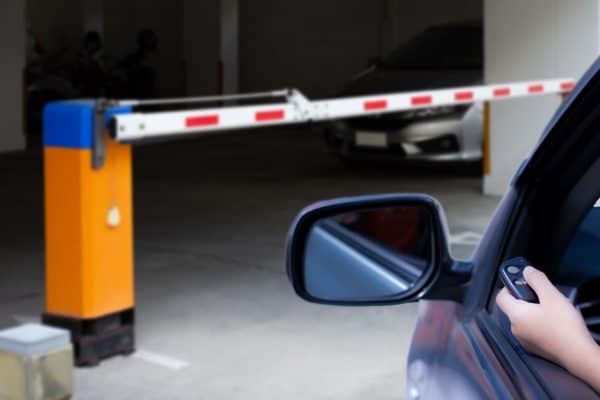
RFID technology plays a vital role in the automotive and access control industries, powering everything from gated community entry and parking management to car wash automation and automatic vehicle identification (AVI). Its core components include UHF RFID tags, readers, and software. Proper RFID tag installation is essential for accurate data capture, reliable vehicle identification, and the long-term durability of tags in demanding outdoor environments. Here, we’ll share practical installation tips that reduce read errors and showcase how EMX supports flawless RFID deployments for vehicle access control and AVI applications.
Understanding UHF RFID Tags for Vehicle Applications
UHF (Ultra-High Frequency) RFID tags are small devices that store and transmit data wirelessly via radio frequency, operating in the 860–960 MHz range. In vehicle and access control applications, UHF RFID offers the long read ranges and fast data transfer rates needed for seamless automatic vehicle identification. There are two main types of RFID tags, each with differences in read range and power source.
Passive UHF RFID tags have no internal battery and are powered by the electromagnetic field from the reader, with a read range of up to 10 meters. These are a cost-effective option widely used in vehicle access control, parking systems, car washes, and gated entry points. Lightweight and compact, passive UHF RFID tags are ideal for windshield-mounted applications, though they may have reduced range near metals or liquids.
Active RFID tags use internal batteries as their power source and have a read range of up to 100 meters or more. While bulkier and more expensive, active tags are well suited for long-range vehicle tracking, toll collection, fleet management, and real-time AVI systems where vehicles need to be identified at high speeds or from greater distances.
In the automotive and access control space, RFID tags take several forms designed specifically for vehicle applications:
• Windshield Tags are designed to be mounted directly on vehicle glass and are commonly used in gated communities, parking garages, and toll systems for seamless AVI.
• Viper Tags can be mounted on various vehicle surfaces, including glass, headlights, or the underside of a side mirror—making them versatile for difficult-to-tag vehicles.
• Hang Tags hang freely from rear view mirrors, making them visible without being obtrusive. They’re popular in residential communities and corporate parking facilities.
• Hard Tags are rugged, often plastic or metal-encased, and ideal for industrial fleet vehicles or outdoor environments exposed to harsh weather.
• Cards are used for driver ID badges and vehicle access systems at controlled entry points.
Form, materials, and environmental factors all affect RFID tag performance. Let’s take a closer look at some key considerations and best practices for RFID tag installation in vehicle and AVI applications.
What Is Automatic Vehicle Identification (AVI)?
Automatic Vehicle Identification (AVI) is a technology that uses UHF RFID to identify vehicles automatically as they approach a reader—without requiring the driver to stop, roll down a window, or present a credential manually. AVI systems pair RFID tags mounted on vehicles with strategically placed readers at entry and exit points, enabling hands-free, high-speed vehicle identification.
AVI is widely used in:
• Gated communities and residential complexes for seamless resident entry and visitor management.
• Parking facilities including commercial garages, corporate lots, and municipal structures for automated access, occupancy tracking, and monthly permit validation.
• Car wash operations for hands-free customer identification, loyalty program automation, and prepaid wash plan redemption as vehicles enter the wash bay.
• Toll collection systems for high-speed, contactless toll processing.
• Fleet management operations for tracking vehicle entry, exit, and usage patterns.
• Secure facilities and restricted zones for authorized-vehicle-only access control.
The effectiveness of an AVI system depends heavily on proper RFID tag installation. A poorly placed tag or misaligned reader can lead to missed reads, delayed gate openings, and frustrated drivers. The installation tips below apply directly to optimizing AVI performance.
Top Considerations Before Installing RFID Tags
Tag Placement
It’s important to position the tag in the reader’s line of sight and maintain adequate spacing from other tags to prevent inaccurate readings. In AVI applications, this means ensuring the tag is placed where the reader can detect it as the vehicle approaches—typically on the windshield or another forward-facing surface. Avoid interference and close proximity to large metal objects or liquids, unless using tags specifically designed for those purposes.
Surface Type
You must carefully consider the mounting surface for your RFID tag installation. Most tags must not be mounted directly on metal or liquid surfaces. On vehicles, this means being mindful of metal frames, body panels, and windshield surrounds. Key surface considerations for vehicle applications include:
• Windshield tags are designed to be mounted on glass and must be kept at least 2 inches away from metal, including the frame that surrounds the windshield.
• Viper tags can be mounted on various surfaces, like glass or non-metal parts. They can be mounted on headlights, the underside of a side mirror, or other difficult-to-tag materials on the vehicle.
• Hang tags hang freely in the air with nothing flat against them, easily hooking over rear view mirrors, making them visible without being obtrusive.
Orientation
Tag alignment impacts read rate, so it’s critical to consider the right placement for the tag reader. The reader should be mounted at least 18 inches away from any concrete or metal surface, and its orientation should be optimized for the approaching vehicle’s path. The reader and tag should be oriented parallel to each other in order to maximize read range—this is especially important in AVI lanes where vehicles pass the reader at speed.
In addition, consider vertical or horizontal orientation. Tag orientation is especially critical for linear polarized readers, like the Patriot-L. The wrong orientation can lead to misreads or inaccurate identification. Another option is a circular polarized reader like the Patriot-E, which is less sensitive to orientation and has a read range of 18 to 25 feet. This can mean more flexibility in tag placement on vehicles and simplified installation at access control points.
RFID Tag Installation Best Practices for Vehicle Access Control
It’s important to properly prepare the mounting surface to ensure tag adhesion and plan placement in order to enhance AVI performance. Ensure the tag is attached securely by double-checking adhesive quality, mechanical fasteners, or embedding. Conduct several read tests post-installation to verify tag performance at the actual entry point, and don’t forget periodic maintenance to ensure tags are continuing to work as required in all weather conditions.
Common mistakes in RFID tag installation include misaligned placement or using the wrong tag type for your vehicle surface. Skipping pre- and post-installation testing or ignoring interference sources, such as metal vehicle components or tinted glass, can also lead to errors. Finally, choosing cheap, low-quality tags will lead to failure in demanding automotive environments, so it’s important to select an access control partner you can trust. That’s where EMX comes in.
How EMX Provides the Best UHF RFID and AVI Solutions
At EMX, we offer a range of high-quality UHF RFID tags purpose-built for vehicle identification and access control. Our durable tags are tailored to automotive applications, from windshield mounts for gated communities and parking facilities to car wash automation and rugged tags for fleet vehicles. Our products are designed for superior read rates and minimal interference in real-world driving conditions—and with a fast 2–3 day lead time, you can get your AVI system up and running without delays. Let us help you choose the right tags for your use case.
We also provide complete solutions to simplify installation, including an RFID mounting stanchion pedestal—a vertical pole on which you can mount the reader at the ideal height for reading vehicle tags. Our RFID ceiling/wall mount bracket extends out from the wall or overhead structure for ease of installation at gates, parking entries, car wash bays, and toll lanes. EMX is dedicated to simplifying installation and ensuring long-term AVI performance.
Ensure that your RFID tags and AVI system are fully optimized for your specific vehicle access needs. Reach out to EMX today for personalized support in finding your ideal solution.