
Patriot-E Standalone Mode: Long-Range RFID Without a Controller
Most long-range UHF RFID installs default to the same architecture: a reader at the gate, a controller cabinet on a wall somewhere, conduit between them, and a software license to manage the credential list. That architecture exists for good reasons — but it isn’t the right answer for every install.
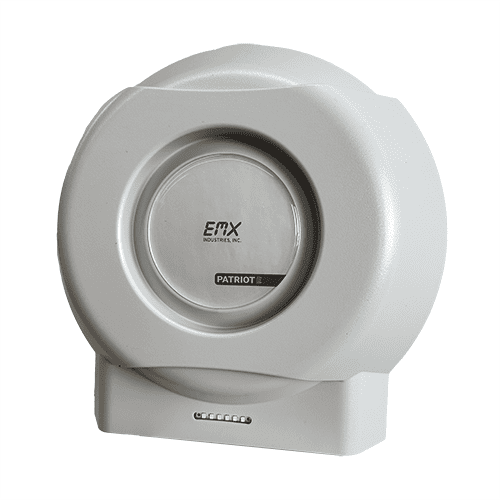
The Patriot-E was built to support a second path. It stores up to 500 authorized tags onboard, in the reader itself. For installs that fit inside that limit, you can skip the controller entirely.
This post covers what standalone mode actually does, when it’s the right spec, and when you should step up to the Defender for full back-end control.
What Standalone Mode Actually Means
In a typical RFID install, the reader is essentially a sensor. It captures a tag ID and sends it upstream to a controller, which checks the ID against an authorized list and triggers the relay. The reader itself doesn’t decide anything.
In standalone mode, the Patriot-E does the deciding. It maintains its own list of authorized tag IDs in onboard memory — up to 500 of them — and triggers its own output when a match comes in. The controller, the centralized software, and the cabinet they live in all drop out of the picture.
That’s the whole concept. The reader does the work the controller used to do, within the limits set by its memory and feature set.
When Standalone Is the Right Call
Standalone mode isn’t a downgrade. For a wide range of installs, it’s the cleaner spec. The fit is strongest when:
- The credential population is bounded. 500 authorized tags is enough for most fleet yards, employee parking entries, gated entry points, small multi-tenant facilities, and after-hours vendor access. If the user count is stable and inside the limit, the controller isn’t doing anything you can’t do at the reader.
- The site has one access point. A single gate, a single overhead door, a single entry pedestal. Adding a controller to a one-relay site is overhead that doesn’t pay back.
- A formal audit trail isn’t required. Standalone mode does not maintain a centralized event log. If the install doesn’t need a 100,000-event record for compliance or investigation, you don’t lose anything by not having one.
- Remote management isn’t necessary. Adding credentials and managing the user list happens at the reader, in person. For sites where the on-site contact handles enrollment anyway, that’s already the workflow.
- The mounting location is remote. Running conduit from a gate post on a 200-foot fence line back to a controller cabinet adds material cost and labor on every install. Standalone removes that run.
For installs that fit those conditions, the result is a simpler bill of materials, a faster install, and fewer points of failure.
When You Should Step Up to the Defender
The Patriot-E pairs with the TRES Defender when the back-end requirements move past what standalone mode can do. Step up when:
- The credential population exceeds 500. Larger sites, growing user bases, or facilities with high turnover hit the standalone limit quickly. The Defender supports up to 20,000 users.
- You’re managing multiple gates or relays. The Defender drives up to four relays and coordinates access across multiple readers from a single management point.
- An audit trail matters. The Defender captures the last 100,000 events, accessible from a Windows PC for review or export.
- Remote management is required. The Defender is IP-addressable. Adding a credential or revoking access can happen from anywhere on the network — useful for property managers, multi-site operators, or anyone who isn’t on the property full-time.
The earlier post on pairing the Patriot-E with the Defender covers that architecture in detail. The point here is that standalone and paired aren’t competing options — they’re the right answers to different requirements.
What the Install Actually Looks Like
A standalone Patriot-E install is short on parts. At minimum:
- The reader, mounted on a gate post, pedestal, or wall
- Power to the reader
- A single output run from the reader to the gate operator, overhead door controller, or relay being driven
- The enrollment process: programming authorized tag IDs into the reader’s onboard memory
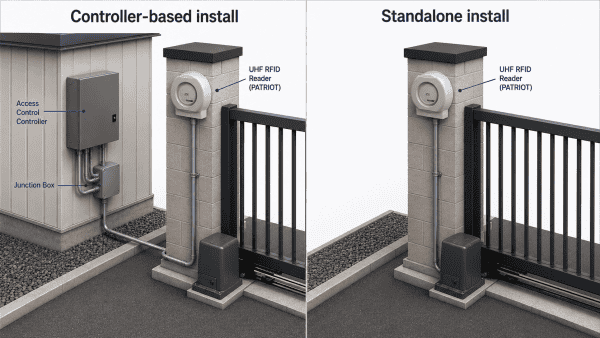
That’s it. No separate enclosure to mount, no controller to ship and install, no software to license, no IP address to assign. For a one-gate site, the entire access point can come down to the reader, the operator it’s wired to, and the tags in the field.
The contrast with a controller-based install is most visible during trim-out: less conduit, fewer terminations, fewer devices to commission.
Protocols and Integration
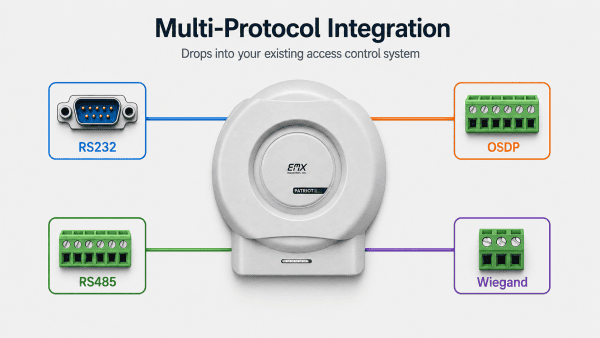
Standalone mode doesn’t mean isolated. The Patriot-E supports RS232, RS485, OSDP, and multiple Wiegand bit formats on the same reader. If you later need to bring it into a larger access control system — whether that’s the Defender, a third-party head end, or a property management platform — the protocols are already there.
For integrators who specify across multiple product lines, this matters: the reader doesn’t lock the site into a single architecture. You can start standalone and migrate to a centralized system later without replacing the reader.
Outdoor and Environmental Considerations
A few things to keep in mind when speccing the Patriot-E for an outdoor install:
- Temperature range. Rated -20°C to +70°C. Suitable for year-round outdoor mounting in most North American climates without supplemental enclosure heat or cooling.
- Read range and tag orientation. The Patriot-E is circular polarized, with a read range of approximately 18 to 25 feet depending on tag type and environment. Circular polarization means tag orientation relative to the reader is much less critical than with a linear-polarized reader — useful when tags are mounted on windshields at varying angles, on the sides of vehicles, or carried in pockets.
- Made in the USA. 100% manufactured in the United States.
Verify the current spec sheet on the Patriot-E product page before final design.
The Decision in One Sentence
If your install has one gate, fewer than 500 credentials, no audit-trail requirement, and someone on site to handle enrollment, standalone mode is the cleaner spec. Once any one of those conditions changes, the Defender pairing is what you want.