
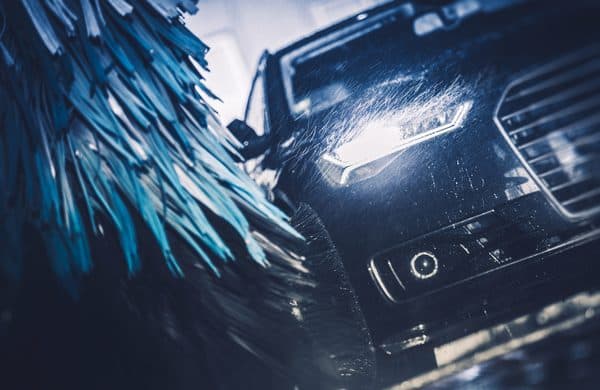
A wash bay door that reverses on nothing costs you a car in the queue every time it happens. A wash bay door that fails to reverse costs you considerably more. Both failures usually trace to the same place: an infrared beam trying to work in an environment built around water, foam, and reflective surfaces.
Photoeyes handle that environment well when they are specified for it and poorly when they are specified the way a dry gate is. This guide covers what the photoeye is doing at a wash bay door, what the bay does to the beam, which EMX configuration fits which site, and how to align it so it holds up after the first month.
Know Which Job You Are Specifying
Photoeyes do two different jobs at a car wash, and they are not interchangeable.
Inside the tunnel, optical sensors handle vehicle positioning: where the car sits on the conveyor, when to trigger an arch, when the wrap has cleared. Those are process controls tied to the wash equipment and they usually come from the wash manufacturer.
At the bay door, the photoeye is an external entrapment protection device. It watches the opening and tells the operator to stop or reverse when something is in the path. That job is governed by UL325, and it is the job EMX photoeyes are built for. Everything below addresses the door, which also means the photoeye has to match the operator’s monitoring method. Check the operator manual before wiring.
What a Wash Bay Does to an Infrared Beam
Three conditions matter, and none of them show up on a spec sheet.
Water sits on the optics. Spray, drift, and condensation attenuate the beam gradually. A photoeye that is aligned cleanly on install day is working through a film by week three, so the operating range you buy matters more here than the span you actually need.
The apron reflects. EMX’s own support guidance names this failure: a wet ground surface can bounce the beam back to the receiver underneath a vehicle, and a wet, shiny vehicle can do the same. The result is a photoeye that reports a clear path while a car sits in the opening. At a wash, the pavement is wet permanently, so this stops being an edge case.
The chemistry is aggressive. Presoak, detergent, and drying agents attack housings and hardware. NEMA 4X is rated for corrosion resistance as well as water, which is the reason to hold the line on 4X rather than accepting a lower rating.
Pro Tip: For any retroreflective install in a wet bay, EMX’s tech support recommends treating the reflector with a hydrophobic product such as Rain-X Plastic. A beaded reflector keeps aligning; a sheeted one goes out of alignment on the first heavy day.
Matching the Configuration to the Bay
IRB-MON2
The universal UL325 thru beam kit, and the default recommendation for a wash bay. The beam makes a single pass from transmitter to receiver, so there is no reflector in the optical path to collect soap film. The kit ships with integrated protective hoods and a removable lens sunshield, four monitoring interfaces, and a 115 ft. operating range, which at a 12 to 14 ft. door leaves a large signal margin available to be eaten by contamination.
Wrong choice when: you cannot get power and conduit to both sides of the opening. A thru beam is two devices and two runs, and if the second run means cutting the apron, the labor can exceed the difference in reliability.
IRB-RET2
The universal UL325 retroreflective kit, and the right answer when one-side wiring is the constraint. It runs 5 to 60 ft. on 6 to 40 VDC or 12 to 24 VAC, carries six monitoring interfaces including 10K resistive, and adjusts sensitivity by potentiometer. The ball and socket bracket and ½-inch NPT conduit connection make aiming and sealing straightforward on a door jamb.
Wrong choice when: nobody is going to clean the reflector. The beam crosses the bay twice on a retroreflective install, out and back, and the reflector sits in the same spray the car does. Where the standard install advice favors retroreflective for the saved cable run, a wash bay adds a recurring maintenance item to that calculation. If reflector cleaning will not make it onto someone’s checklist, put the second device up instead.
IRB-4X2
A thru beam kit with the same 115 ft. range and the same integrated hoods and removable lens sunshield, for openings where the operator does not require a monitored interface.
Wrong choice when: the operator requires a monitored connection. Confirm that first, because the monitoring method cannot be added later in the field.
Compare and Contrast: For the full side-by-side on the two universal units outside of a wash context, see MON2 vs RET2: Choosing Your Ideal Universal Photoeye.
Alignment and Sensitivity in a Wet Bay
A 115 ft. unit across a 14 ft. opening runs at a fraction of its capability, and that headroom is what keeps the beam above threshold once the lens has a film on it.
Set sensitivity the way EMX’s support team describes, then respect the second half of the instruction. Turn the dial fully clockwise to maximum, align the unit, then back sensitivity down as far as it will go while the red indicator stays on solid. Leaving it at maximum is what produces the wet-apron failure above, because a hot receiver will accept a beam bounced off standing water. If a vehicle in the opening does not register, turning sensitivity down is the first thing to try.
Two field checks worth building into the install:
- Center the reflector in the cone. On a retroreflective unit, hold the reflector at least 5 ft. out and move it in a circle to find where the indicator starts to flash. Mount at the center of that cone rather than at the edge of it.
- Verify the transmitter with a phone. Look into the transmitter lens through a phone camera. A crescent or circle of violet light confirms the transmitter is emitting before you start chasing wiring.
Protect the mounting position while you are there. A wash entrance sees mirrors, door handles, and the occasional bumper at the height a photoeye lives. EMX’s photoeye enclosures and mounting posts put the sensor behind steel while leaving the optical path open.
Spec the Door With Someone Who Has Seen One
Wash bays vary more than the door width suggests. Reclaim spray, bay orientation, drying position, and whether the apron drains or ponds all change how a beam behaves, and that is before the operator brand dictates a monitoring method.
Start with the photoeye selection guide and the car wash sensor recommendations for the loops and detectors that go in alongside. Then describe the bay to someone who can size it with you. Find your local EMX distributor or contact our team to work through the door.